Monday, June 8, 2015

Cabo Survives Hurricane Blanca

Souvenir alley, leading from Cabo San Lucas to the marina, gets a cleanup Monday after a near-miss by an early hurricane.
Sounds like Bill Monroe reporting for Oregon.Live was in Cabo when he filed this report:

The wind howled. Boats bounced in the harbor. Birds hunkered.

And in the end? Hurricane Blanca largely spared Cabo San Lucas a double punch from last year's devastating storm.

Even at the storm's height, one or two hard-core souvenir sellers were hawking wares to the few passing gringos out watching the wind and the boats in one of the highest-value marinas on earth.

Read more at Shake N Bake, Cabo San Lucas, survive Hurricane Blanca

Friday, June 5, 2015

Day Trip to Pozos

John and Kristine Scherber
The Scherbers and the Landfairs spent part of the day today in Pozos, an hour's drive from San Miguel on a narrow road. The day was partly cloudy and we took along a jacket in case it was chilly in Pozos. Sometimes the weather is cooler than San Miguel because the altitude is 7,200 feet; 500 to 1,000 feet higher than SMA.

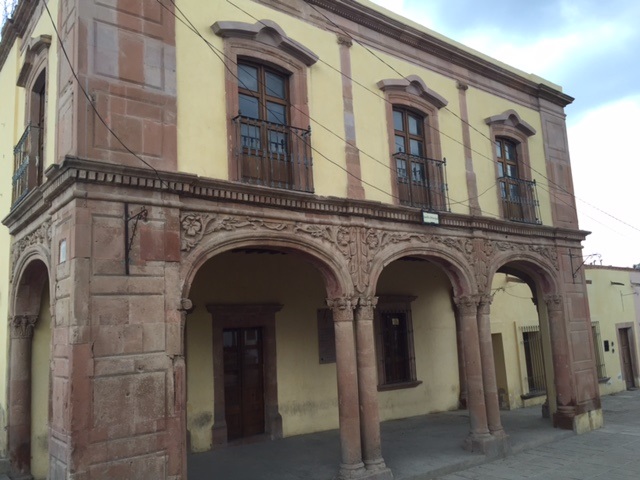
When we drive into town, I was struck by all the work that has been done to make the World Heritage city attractive to tourists. It looks like a new sewer line is going in. Maybe authorities are expecting more than just tourists. I noticed new brick work everywhere in the city of 2,000 to 3,000 people, along with new doors. The doors and brick work are a kind of facade for poverty that exists behind the doors.

We drove through the town toward the mining district and passed haciendas that were built for living and for production of silver. In the late 1800s to the early 1900s the population was about 70,000 people, then when the mines were flooded, either accidentally or on purpose, Pozoz became a ghost town and the population fell to about 300. Today, it is trying to come back and expats number less than 20.


The haciendas have been abandoned and the once great buildings have collapsed into ruin, much like the ruined Jarel de Berrio hacienda. We took many pictures of one of the largest haciendas, Mina Cinco Señores the five senors mine. It is a shame that so much lies in ruins, covered in graffiti in many rooms. On e sign indicated this area was mined beginning in the mid 1550s.


Carved lizard helping you wash
Cowboy hat light fixtures

After we toured the mining area and took pictures of the flowing century plants, we made our way to Posada de las Mina for lunch. blue corn and dried banana slices were served with delicious salsa; one was a hot red sauce and the other was tangy with a lemony taste. We ordered food that was very good. I had enchiladas filled with chicken tinga and topped with a red mole sauce different from the dark coffee and chocolate moles I've tasted previously. The food was very good and the bill for four came to 510 pesos. A steal!

Reclaimed building faces the square

During the drive through Pozos, we stopped at a little shop that had all sorts of rocks for sale. I bought two rock samples from the area. One was a sample of copper ore and the other of plata or silver.


The intricate ironwork by the patio

It was a fantastic day filled with great conversation, great food and conversations about writing.


Corrected: so many typos!

The Rio Grande nexus

Mexico is becoming a vibrant middle-class nation. Already, it is the largest trading partner of California, Texas and Arizona, and is responsible for hundreds of thousands of jobs across the Southwest. And that might be just the beginning. With economic and educational reforms under way, Mexico’s rise could accelerate. By one estimate, Mexico will be the world’s fifth-largest economy by 2050.

What will the emergence of a First World Mexico mean for the Southwest?

The Rio Grande nexus

By Michael Lind

The Rio Grande, which once divided the hinterlands of two countries, is becoming the seam that stitches together two of their most dynamic regions. North of the river, the revolution in oil and gas production enabled by hydraulic fracturing (fracking) has produced an economic boom in the land above the 23-county Eagle Ford Shale. Further north, the Texas Triangle bounded by Austin-San Antonio, Dallas-Fort Worth and Houston is exploding in population and prosperity, as it attracts migrants and jobs from the rest of the country and the world.

Meanwhile, the region south of the Rio Grande is the most prosperous in Mexico. Monterrey, the economic capital of the area, is the second-wealthiest city in Mexico, hosting affiliates of multinationals including General Electric and Toyota. The Mexican states in the Rio Grande Basin — Durango, Chihuahua, Coahuila, Nuevo Leon and Tamaulipas — have a per capita GDP that is 2.3 times higher than that of the rest of the country. In Mexico as a whole, the middle class has grown to include as much as 40 percent of the population. As rates of Mexican fertility and immigration fall, the Great Migration from rural Mexico to the U.S. appears to have been a one-time phenomenon, like the Great Migration of rural blacks and whites to the Northern U.S. between the two world wars.

The continuing challenges of crime and poverty along the border should not obscure the outlines of a historic transformation in North America. The centers of economic dynamism in both the U.S. and Mexico — nations predicted to have the second- and fifth-largest economies in the world by 2050 — are converging at la frontera. A new transnational core in the global economy, like the Benelux nations of Europe and the concentration of wealth in East Asia, is emerging on both sides of the area between the Rio Grande and Nueces rivers once known as the Wild Horse Desert. In an age obsessed with bad news, this is very good news indeed.

Michael Lind is co-founder of the New America Foundation and author of “Land of Promise: An Economic History of the United States.”

Thursday, June 4, 2015

Rebozo is Endangered, says Textiles Expert

Ana Celia Martínez, expert in Mexican textiles.
Mexico News Daily says the "The Mexican rebozo, a traditional garment closely associated with Mexican culture, is on the brink of extinction, according to an award-winning expert in textiles.

"Ana Celia Martínez, winner of the Tenerife International Artisan Prize 2014, worries that there are fewer than 200 people dedicated to the weaving of rebozos left in Mexico. Just a few months ago, she says, the last weaver of scented rebozos had to close his shop.

“Scented rebozos are 100% cotton, and to achieve their characteristic black color, artisans had to treat the fiber with iron and treated water. This complicated process impregnated the fabric with foul smells. The rebozo was then curated with fragrant herbs, giving the garment its name”, explains Martínez, who is also a professor of Mesoamerican studies at the National Autonomous University.

“Scented rebozos are widely appreciated in Europe,” she says, but “now this tradition has become part of history, to be displayed in museums. This variety of rebozo is practically extinct.”

"Another example of an endangered rebozo is the “reservista,” in which 5,000 threads are woven on a backstrap loom, achieving intricate and complex designs. “There is only one artisan working this type of rebozo in Mexico.”

"The Mexican rebozo, a long straight piece of cloth that could be a cross between a scarf and a shawl, is known for its durability, and they can be passed on from generation to generation. The rebozo can be described as an accessory but it is also functional, being used to carry large bundles, or babies.

"Martínez describes the the latter use: “The child is completely covered by it, comfortably pressed against its mother’s body in an assuring and soothing position. They can even hear their mother’s heartbeat.”

"Martínez is confident that the National Anthropology and History Institute will protect something with such a strong cultural tradition: “They must undertake concrete actions to preserve this part of the culture of Mexico, and prevent the displacement of artisans by cheap Chinese products.”

"Chinese rebozos are inexpensive and mass-produced using synthetic fibers. The end product is very fragile and frays very easily and the dyes wash off after a short time, while Mexican rebozos can remain intact for decades, says Martínez.

"The defender of culturally valuable textiles won the Tenerife prize for “Izote, Iczotl, fiber with identity, tradition and permanence,” a project designed to preserve an endangered type of fiber called izote, which is produced in Zumpahuacán in the State of México.

"Izote is seen to have historical importance because its use in pre-Hispanic times is evident in documents such as the Codex Mendoza, a 16th-century manuscript containing a history of Aztec rulers, where the pictograms show izote blankets.

"Upon receiving her award, presented on the island of Tenerife in February, Martínez said cultural traditions such as the rebozo are “the symbols of our identity” and must be preserved - See more at:

Cabo Web Cam to Watch the Storm

http://www.cabovillas.com/properties.asp?PID=219&source=AAC&NCK=8554566700#livecam

Wednesday, June 3, 2015

Hurricane Blanca May or May Not Drench the Southwestern U.S. Next Week


Hurricane Blanca is only the second named storm in the three-week-old Pacific Hurricane Season, but it’s already the second category four hurricane to form there in the past two days. The storm will slowly move towards the Baja Peninsula this weekend, after which it might or might not drench the American Southwest.n>

Are there Americans Living (and even working) illegally South of the Border?


The issue of undocumented Mexican migrants in America is widely reported. But what about the thousands of Americans living illegally south of the border? Does anybody know why they come, and why Mexicans aren’t yet making an issue about it?

Last year about 1,000 US citizens were questioned over irregularities in their immigration status, according to Mexican authorities. They face a modest fine – up to $50 – if officials find them working without a permit or living in Mexico without proper documents.

Those who lose their visas or are asked to leave the country and then discovered to be overstaying are fined up to $400.

But truth is, the National Migration Institute in Mexico has absolutely no idea just how many Americans are living or working illegally in Mexico.

There are no advocacy groups defending American aliens in Mexico. Mexican politicians haven’t raised it as a major issue – a far cry from the controversy around illegal migration on the other side of the border. With thousands of people from Central America crossing into Mexico illegally every year, and the threat from drug gangs and human traffickers on their way to the US, the presence of undocumented Americans is considered little more than a minor issue for Mexico’s immigration services.

Some are American tourists who decide to extend their stay in Mexico without notifying the authorities, or students who wish to earn extra money teaching English in Mexico City. Others just fall in love with the Latin American lifestyle.

Read the rest of the article at http://www.theyucatantimes.com/2015/06/are-there-americans-living-and-even-working-illegally-south-of-the-border/