Did you know that Puerto Vallarta Celebrates 100th Anniversary May 25-31 says Marie Callan - BanderasNews.com
From May 25-31, 2018, Puerto Vallarta will commemorate its 100th anniversary as a municipality and 50th year as a city with a week-long celebration that includes cultural events, concerts, fireworks, and more. Share
Puerto Vallarta, Mexico - On May 31, 2018, Puerto Vallarta will celebrate the 100th anniversary of its induction as a municipality and 50th of its elevation to the category of city - and it promises to be a gala affair!
But first, a little history...
During the first part of the 1800s, this beautiful piece of Mexican geography remained isolated from the rest of the world. The hubs of economic activity were up in the mountains, in the towns of Cuale, San Sebastián and Mascota, where silver mines abounded but where salt, an essential element for processing the metal, was not to be found.
The village which was to become Puerto Vallarta was founded in 1851 by Guadalupe Sanchez, an enterprising boatman from Cihuatlán, who established a trading post on the banks of the Cuale River to supply salt to the mountain gold and silver mines, whose minerals were transported to this coast for shipping.
Sanchez originally called Puerto Vallarta "Las Peñas de Santa María de Guadalupe" to commemorate his arrival on December 12, the day of the Virgin of Guadalupe. In 1911, the people of Las Peñas asked the government of the state for the status of municipality, and finally on the 31 of May, 1918, the State Congress decreed to the formation of the municipality, changing the name to Puerto Vallarta to honor an important governor of the State of Jalisco, Don Ignacio Luis Vallarta.
Since then, every year in May, the people of Puerto Vallarta have gathered together in El Centro to celebrate the municipality's anniversary. But this year's celebration promises to be bigger and better than ever as Puerto Vallarta celebrates 100 years!
Showing posts with label Puerto Vallarta. Show all posts
Thursday, May 17, 2018
Puerto Vallarta Celebrates 100th Anniversary
Thursday, October 22, 2015
Hurricane Patricia Comes Ashore late Friday
Turbo-charged Hurricane Patricia is on track to deliver a devastating one-two punch: landfall as a major hurricane on Mexico's Pacific coast, followed by the storm feeding an extreme rainfall event in parts in Texas. Drawing on near record-warm sea-surface temperatures of 30.5°C or 87°F (1-2°C above average), Patricia is also taking advantage of very light wind shear (5 - 10 knots) and rich atmospheric moisture (greater than 70% relative humidity). Within a span of just 27 hours, from 15Z Thursday to 18Z Friday, Patricia metamorphosed from a minimal tropical storm (top sustained winds of 40 mph) to a Category 4 hurricane (130 mph). This puts Patricia among the top rapid intensifiers in the modern record of hurricane monitoring. Stepped Frequency Microwave Radiometer (SFMR) data collected from aboard a NOAA Hurricane Hunter reconnaissance flight confirmed a peak wind of 114 knots (131 mph) on Thursday afternoon near 1:30 pm EDT.
Thursday, September 17, 2015
If you love unspoiled Mexico, meet Nayarit
"Almost everyone has heard of Puerto Vallarta," IRENE MIDDLEMAN THOMAS said, "the long-popular Mexican vacation destination in Jalisco that draws droves of vacationers from the United States and Canada each year (along with many who have moved there permanently.) But there is much more to explore and enjoy outside of the beautiful city in the heart of the sparkling Bay of Banderas."
This region is full of dense jungle foliage — where towering ferns, palms and vines join together in jumbles of tumbling bougainvillea and hibiscus surrounding azure Pacific waters. The dense mountains loom behind at various angles, making for landscapes Gauguin would have loved to paint.
We’ve visited numerous times, and we never run out of new places to see.
From the Puerto Vallarta Los Muertos beach pier to Yelapa, an itsy-bitsy pedestrian-only village hugging the rocky coast at the southern tip of the bay.
Somewhat reminiscent of an Italian fishing village, Yelapa has a rather weird melange of bohemian Yanks, Canadians and Europeans, some living in lavish villas, others residing in humble abodes alongside the friendly locals.
Just 10 minutes north of the international airport, we entered the state of Nayarit.
Never heard of it? Mexico’s 10th smallest state (out of 31), is a diverse destination that attracts birdwatchers, wildlife enthusiasts and those seeking a taste of the authentic, unsullied-by-tourism Mexico.
On our weeklong visit, we traveled through a scenic green countryside with rolling hills, enjoying endless views of sugar cane fields with fronds blowing in the breeze; mango, banana, and papaya orchards; and tobacco farms.
Read more of Thomas's travel near Puerto Vallarta here.
This region is full of dense jungle foliage — where towering ferns, palms and vines join together in jumbles of tumbling bougainvillea and hibiscus surrounding azure Pacific waters. The dense mountains loom behind at various angles, making for landscapes Gauguin would have loved to paint.
We’ve visited numerous times, and we never run out of new places to see.
From the Puerto Vallarta Los Muertos beach pier to Yelapa, an itsy-bitsy pedestrian-only village hugging the rocky coast at the southern tip of the bay.
Somewhat reminiscent of an Italian fishing village, Yelapa has a rather weird melange of bohemian Yanks, Canadians and Europeans, some living in lavish villas, others residing in humble abodes alongside the friendly locals.
Just 10 minutes north of the international airport, we entered the state of Nayarit.
Never heard of it? Mexico’s 10th smallest state (out of 31), is a diverse destination that attracts birdwatchers, wildlife enthusiasts and those seeking a taste of the authentic, unsullied-by-tourism Mexico.
On our weeklong visit, we traveled through a scenic green countryside with rolling hills, enjoying endless views of sugar cane fields with fronds blowing in the breeze; mango, banana, and papaya orchards; and tobacco farms.
Read more of Thomas's travel near Puerto Vallarta here.
Labels:
Puerto Vallarta,
Punta Mita,
Sayulita,
Yelapa
Friday, January 2, 2015
Puerto Vallarta - January 2, 2015
In a growing trend over the last several years, Puerto Vallarta is once again named as a top retirement destination by a travel magazine.
International Living’s list of best places to retire in 2015 says Puerto Vallarta’s expat community makes for an easy transition into international living while also offering real estate deals much lower than what you would find in the United States.
In May, CNN featured a story on expats living in Puerto Vallarta, estimated to be over 40,000 around the bay and over one million nationwide. That was shortly after US News and World Report named Puerto Vallarta as a top retirement haven for expats which they titled “an affordable and sophisticated haven for expats”.
Peddicord’s retirement index, a group that ranks the affordability and overall quality of life for retirees, named Puerto Vallarta among the best international destinations for retiring on a budget and high marks for quality of life.
With tourism on the rise in Puerto Vallarta and closing out one of its best years in 2014, more people are taking notice of Puerto Vallarta as more than just a place to visit.
International Living ranked Puerto Vallarta just below Ecuador and Panama which offer slightly lower cost of living due to smaller nation economies.
Puerto Vallarta offers a vibrant expat community and organizations that can help people interested in retiring to the area. Expats in Vallarta is an excellent source of information and also a great way to meet people in the expat community while in Puerto Vallarta.
Labels:
expat,
expats,
International Living,
Puerto Vallarta,
Travel
Location:
Puerto Vallarta, JAL, Mexico
Friday, October 24, 2014
Know Nayarit
Small state offers a different world of beauty, adventure and culture
By Irene Middleman Thomas, Special to the Sun
October 14, 2014
Visitors can enjoy the beach in San Blas and explore the nearby mangroves and hilly rainforest where a multitude of birds, both local and migratory, fill the air with song. The beach is long and wide in San Blas.
Sitting
at a bright-red table overlooking an estuary in the fabled village of
Mexcaltitan in the Riviera Nayarit, we threw bits of tortillas in the
air to acrobatic sea birds to catch mid-flight.
Dozens of great white pelicans floated by on the green water, while a family lustily sang Las Mananitas, Mexico’s birthday song, nearby.
Nayarit’s beloved “pescado zarandeado” — a whole snapper, caught that morning, grilled on aromatic mangrove wood and served with homemade corn tortillas, grilled scallions, cucumbers, tomatoes — plus a delectable shrimp paté with crackers were available. Icy cold Pacifica beers in hand, we marvelled that such a place still exists.
Never heard of Nayarit? It is Mexico’s 10th smallest state (out of 31) and incredibly diverse — birdwatchers, wildlife enthusiasts and those seeking the authentic, unsullied-by-tourism Mexico are drawn to it.
On a recent weeklong visit, we travelled through green rolling hills, endless sugarcane fields with fronds blowing in the breeze — and mango, banana, papaya and tobacco farms.
We were just a few yards from enormous crocodiles, inches from an exquisitely beautiful jaguar, viewed thousands of migratory birds in the emerald-green rainforest. We were also eating succulent dishes we had never heard of, and meeting fascinating people from all walks of life, such as elaborately adorned Huichol Indians still living their traditional lifestyle.
It’s easy to travel from one fascinating part of Nayarit to another. Nayarit’s southern border is just 10 minutes north from the Puerto Vallarta airport. The modern, intercoastal highway is serviced by comfortable, air-conditioned buses that stop in each town — with very reasonable fares.
If you want the mega all-inclusives overlooking the Pacific, luxury spas, fabulous surfing, world-class golfing and lie-on-the-beach vacations, it’s all in the Riviera Nayarit; but if you yearn for adventure, colonial architecture and art and a heady dip into other cultures, venture into the rest of the state and “know Nayarit.”
The Nayarit Colonial zone offers Spanish colonial architecture, history and museums of the capital city of Tepic (founded in 1542) as well as the delightful cobblestoned villages of Jala, Ixtlan del Rio and Bellavista. Tepic is a bustling, lively city perfect as a base for exploration of nearby Huichol Indian villages and other areas.
We enjoyed walking the lively Plaza de Armas with its enormous cathedral and beautiful Municipal Palace, as well as the Amado Nervo, Museo de las Cuatro Culturas (Museum of Four Cultures) and Juan Escutia museums, and gazed for a long while at a father and small son cutting, trimming and bagging sugar cane stalks at their street stand.
Nayarit has several spectacular “enchanted lagoons” such as San Pedro, Tepetiltic and Santa Maria del Oro, where we spent the night in a rather swank, modern boutique 20-room hotel called Lago Encantado.
The morning there was breathtaking — with mist rising over the lake and layers of multi-hued mountains rising beyond. People come to these towns to fish, bike, water ski, boat, rest and to enjoy the area’s famous delicacies.
We started our Riviera Nayarit exploration in the large town of San Blas (founded in the 17th century,) renowned as one of the world’s most important natural bird refuges.
Dozens of great white pelicans floated by on the green water, while a family lustily sang Las Mananitas, Mexico’s birthday song, nearby.
Nayarit’s beloved “pescado zarandeado” — a whole snapper, caught that morning, grilled on aromatic mangrove wood and served with homemade corn tortillas, grilled scallions, cucumbers, tomatoes — plus a delectable shrimp paté with crackers were available. Icy cold Pacifica beers in hand, we marvelled that such a place still exists.
Never heard of Nayarit? It is Mexico’s 10th smallest state (out of 31) and incredibly diverse — birdwatchers, wildlife enthusiasts and those seeking the authentic, unsullied-by-tourism Mexico are drawn to it.
On a recent weeklong visit, we travelled through green rolling hills, endless sugarcane fields with fronds blowing in the breeze — and mango, banana, papaya and tobacco farms.
We were just a few yards from enormous crocodiles, inches from an exquisitely beautiful jaguar, viewed thousands of migratory birds in the emerald-green rainforest. We were also eating succulent dishes we had never heard of, and meeting fascinating people from all walks of life, such as elaborately adorned Huichol Indians still living their traditional lifestyle.
It’s easy to travel from one fascinating part of Nayarit to another. Nayarit’s southern border is just 10 minutes north from the Puerto Vallarta airport. The modern, intercoastal highway is serviced by comfortable, air-conditioned buses that stop in each town — with very reasonable fares.
If you want the mega all-inclusives overlooking the Pacific, luxury spas, fabulous surfing, world-class golfing and lie-on-the-beach vacations, it’s all in the Riviera Nayarit; but if you yearn for adventure, colonial architecture and art and a heady dip into other cultures, venture into the rest of the state and “know Nayarit.”
The Nayarit Colonial zone offers Spanish colonial architecture, history and museums of the capital city of Tepic (founded in 1542) as well as the delightful cobblestoned villages of Jala, Ixtlan del Rio and Bellavista. Tepic is a bustling, lively city perfect as a base for exploration of nearby Huichol Indian villages and other areas.
We enjoyed walking the lively Plaza de Armas with its enormous cathedral and beautiful Municipal Palace, as well as the Amado Nervo, Museo de las Cuatro Culturas (Museum of Four Cultures) and Juan Escutia museums, and gazed for a long while at a father and small son cutting, trimming and bagging sugar cane stalks at their street stand.
Nayarit has several spectacular “enchanted lagoons” such as San Pedro, Tepetiltic and Santa Maria del Oro, where we spent the night in a rather swank, modern boutique 20-room hotel called Lago Encantado.
The morning there was breathtaking — with mist rising over the lake and layers of multi-hued mountains rising beyond. People come to these towns to fish, bike, water ski, boat, rest and to enjoy the area’s famous delicacies.
We started our Riviera Nayarit exploration in the large town of San Blas (founded in the 17th century,) renowned as one of the world’s most important natural bird refuges.
While
birdwatching here is wonderful all year, its rich migratory display
every winter season (November-April) brings an estimated 80 per cent of
the migratory North American bird species to interact with local
species, about 2½ hours north of the Puerto Vallarta airport. Caution —
you will need insect repellent in this area!
In San Blas, we stayed at the very pretty Garza Canela, a garden-filled inn run by the four very friendly Vazquez sisters (one of whom is Betty Vazquez, an acclaimed Paris-educated chef, and the Culinary Ambassador for the Riviera Nayarit) and their brother.
This property caters to bird watching groups, provides very early breakfasts to birders, and is just a 15-minute walk from the town’s long sandy beach. The Delfin restaurant, with Chef Betty’s gastronomic marvels (written up in Bon Appétit and Gourmet) is well worth the trip. The Garza Canela sisters will help you book the services of a very reliable and knowledgeable taxi driver, Juan Martinez Velez, who regularly attends to international visitors and can be booked in advance for private trips in the area.
But there’s much more to San Blas — the nearby dense mangroves and hilly rainforest’s microclimate attract thousands of birds to mate, nest and feed in the nutrient-rich estuary. One morning, we arose before sunrise to climb up through the rocky paths at Tecuitata, through impossibly dense mango, jackfruit, banana and papaya trees, and as the first rays of sunlight hit us, so did the cacophony of sound — birds calling, singing, and cawing all around us, along with crickets and woodpeckers. Our bilingual guide, expert birdwatcher Francisco Garcia, called in excitement to us when he spotted a squirrel cuckoo.
The next morning, we skimmed the glasslike surface of the estuary in a small panga boat to enter the peaceful and beautiful La Tovara, a mangrove refuge filled with about 60 crocodiles, a multitude of turtles, lizards and herons, storks, hawks, eagles, egrets, ducks, falcons and more.
About a 45-minute drive from San Blas, small boats take visitors to the fascinating village of Mexcaltitan, mentioned above. This no-vehicle village of 1,800 residents is only reachable by boat; inside the estuary, this delightful town is completely walkable (after dining on that fabulous fish mentioned above — try La Alberca, about $25 per couple for enormous fish and shrimp lunch with beer). Everyone’s doors are open, children are outside playing, the church has an exceptionally bloody Jesus Christ statue, and there is a surprisingly well executed small historical museum (Museo del Origen).
Stroll the paths into yesteryear and slow down — what would it be like to live here, we wondered. In fact, we learned that some locals have never left — afraid to experience cars, noise and big city life.
As our magical day in Mexcaltitan drew to a close, we embarked onto the little boat alongside some 25 great white pelicans. It was a day like no other we’ve ever had.
For our time of sun and surf, we headed back to Riviera Nayarit. We chose picturesque San Pancho (formally called San Francisco), where we stayed at the lovely Cielo Rojo boutique hotel, perfectly decorated with Mexican folk art. In San Pancho, we visited the fabulous Entreamigos Community Center — a utopia-like non-profit established and run by a former Californian. It is well worth an hour of your time.
Moving on to Bucerias, we stayed in an outstanding ecoproperty. Los Arroyos Verdes is a botanical garden built around 36 private casitas, a restored Airstream trailer and small RV, with 26 staffers attending to the organic chef’s garden, nursery, authentic Temazcal sweat lodge, maintenance, activities (yoga, tai chi, salsa dancing, etc.). We explored the surrounding countryside on the cute vintage bicycles, and swam in the huge azure swimming pool.
Knowing Nayarit is a joy, one that takes much more than one trip there — this gloriously beautiful, lush, authentically Mexican destination will happily fill your minds, hearts and stomachs.
For more information, visit www.rivieranayarit.com
In San Blas, we stayed at the very pretty Garza Canela, a garden-filled inn run by the four very friendly Vazquez sisters (one of whom is Betty Vazquez, an acclaimed Paris-educated chef, and the Culinary Ambassador for the Riviera Nayarit) and their brother.
This property caters to bird watching groups, provides very early breakfasts to birders, and is just a 15-minute walk from the town’s long sandy beach. The Delfin restaurant, with Chef Betty’s gastronomic marvels (written up in Bon Appétit and Gourmet) is well worth the trip. The Garza Canela sisters will help you book the services of a very reliable and knowledgeable taxi driver, Juan Martinez Velez, who regularly attends to international visitors and can be booked in advance for private trips in the area.
But there’s much more to San Blas — the nearby dense mangroves and hilly rainforest’s microclimate attract thousands of birds to mate, nest and feed in the nutrient-rich estuary. One morning, we arose before sunrise to climb up through the rocky paths at Tecuitata, through impossibly dense mango, jackfruit, banana and papaya trees, and as the first rays of sunlight hit us, so did the cacophony of sound — birds calling, singing, and cawing all around us, along with crickets and woodpeckers. Our bilingual guide, expert birdwatcher Francisco Garcia, called in excitement to us when he spotted a squirrel cuckoo.
The next morning, we skimmed the glasslike surface of the estuary in a small panga boat to enter the peaceful and beautiful La Tovara, a mangrove refuge filled with about 60 crocodiles, a multitude of turtles, lizards and herons, storks, hawks, eagles, egrets, ducks, falcons and more.
About a 45-minute drive from San Blas, small boats take visitors to the fascinating village of Mexcaltitan, mentioned above. This no-vehicle village of 1,800 residents is only reachable by boat; inside the estuary, this delightful town is completely walkable (after dining on that fabulous fish mentioned above — try La Alberca, about $25 per couple for enormous fish and shrimp lunch with beer). Everyone’s doors are open, children are outside playing, the church has an exceptionally bloody Jesus Christ statue, and there is a surprisingly well executed small historical museum (Museo del Origen).
Stroll the paths into yesteryear and slow down — what would it be like to live here, we wondered. In fact, we learned that some locals have never left — afraid to experience cars, noise and big city life.
As our magical day in Mexcaltitan drew to a close, we embarked onto the little boat alongside some 25 great white pelicans. It was a day like no other we’ve ever had.
For our time of sun and surf, we headed back to Riviera Nayarit. We chose picturesque San Pancho (formally called San Francisco), where we stayed at the lovely Cielo Rojo boutique hotel, perfectly decorated with Mexican folk art. In San Pancho, we visited the fabulous Entreamigos Community Center — a utopia-like non-profit established and run by a former Californian. It is well worth an hour of your time.
Moving on to Bucerias, we stayed in an outstanding ecoproperty. Los Arroyos Verdes is a botanical garden built around 36 private casitas, a restored Airstream trailer and small RV, with 26 staffers attending to the organic chef’s garden, nursery, authentic Temazcal sweat lodge, maintenance, activities (yoga, tai chi, salsa dancing, etc.). We explored the surrounding countryside on the cute vintage bicycles, and swam in the huge azure swimming pool.
Knowing Nayarit is a joy, one that takes much more than one trip there — this gloriously beautiful, lush, authentically Mexican destination will happily fill your minds, hearts and stomachs.
For more information, visit www.rivieranayarit.com
Labels:
Bucerias,
Puerto Vallarta,
Riviera Nayarit,
San Blas,
Travel
Thursday, October 23, 2014
V Conchas Chinas in Puerto Vallarta
A wonderful place to live when finished.
Tuesday, September 30, 2014
Three Top Picks For Living In Mexico
Glynna Prentice wrote in International Living: "With more than a million expats estimated to live there, Mexico is far and away the most popular destination for North Americans looking to move abroad. But—with so many places to choose from—where in Mexico should you move? It’s a very large country, after all.
Much depends, of course, on what you’re looking for. There are places in Mexico where you can live totally off the grid, or immerse yourself in a small village where there’s nary a foreigner around you. Alternatively, there are cities and neighborhoods where you can live a gringo life, never seeing a local and never needing Spanish.
Most expats seek something between these two extremes: places where the transition to Mexico is easy (and so is getting there), amenities abound, and local culture and color are all around. Based on that happy medium, here are my three top picks for living in Mexico.
Labels:
expats,
Merida,
Mexico,
Puerto Vallarta,
San Miguel,
San Miguel International Writers’ Conference,
Travel
Saturday, September 27, 2014
AARP: Best Places to Retire Abroad - Mexico
With its profoundly rich Indian and Spanish culture, its spectacular beaches and charming colonial hill towns, its real estate bargains and its proximity to the United States, Mexico is the undisputed number one destination for American retirees. It boasts thriving expat communities in Lake Chapala, near Guadalajara; San Miguel de Allende, in Guanajuato; Baja California; and Cancún, in the Yucatan. They all have their attractions, including a low-cost, laid-back lifestyle, but our choice in Mexico is the Puerto Vallarta region, located on the Pacific Coast in the state of Nayarit. Its combination of first-class urban amenities and charming palm-fringed villages have made it an appealing retiree draw as well as a popular tourist destination, without the serious crime that blights some other parts of the country.
(A quick word about crime and safety in Mexico: Yes, it's extremely dangerous in the cities bordering the United States and a few places elsewhere. Mexico, however, is also nearly three times the size of Texas, and most of the country is reasonably safe and secure, especially resort areas and tourist destinations.)
Puerto Vallarta's handsome beachfront promenade can be overcrowded with tourists, but venture a few blocks back from the bars and curio shops, and the town's Mexican charms are on display—whitewashed houses bedecked with flowers, and plazas where locals and expats alike greet, eat, and seat themselves on benches to watch the passing parade. In Nuevo Vallarta, the newer luxury area, you’ll find U.S.-style condo complexes and even a mall. You’d think you're back in the States, but at a steep discount.
Forty minutes north of PV, the seaside village of Sayulita is a lively place, with a colorful mix of tourists, retirees, and surfer dudes that keeps things hopping. Rollie Dick, 70, and his wife, Jeanne, 65, both former teachers from California, own and operate the town’s most popular restaurant—Rollie’s—known for its delicious quesadillas and a chef who dances his guests around the tables. "We love the plaza life," Dick says. "It reminds me of the States in the ’50s."
The one thing expats most appreciate about life here: the traditional Mexican friendliness. Peter Glass, 65, a former Procter & Gamble executive, lives with his wife, Charlotte, in a charming small house in Sayulita. An African American from Washington, D.C., he says that "Mexico is the only country I’ve experienced where I haven’t felt that I was being judged one way or the other by the color of my skin. It is a breath of the proverbial fresh air."
Check out our traveler's guide to Puerto Vallarta.
Labels:
On the beach,
Puerto Vallarta,
Travel
Location:
Puerto Vallarta, JAL, Mexico
Thursday, August 28, 2014
Immigration vs Emmigration
Breitbart reports that a new Pew survey of Mexicans says that 1/3 of Mexicans would like to live in U.S.:
"...roughly a third (34%) still say they would move to the U.S. if they had the opportunity,..."
"Through an agreement with the Las Palmas Hotel, Puerto Vallarta-based Front Beach Retirement converted the 225 rooms of the all-inclusive hotel into an independent and assisted living community, Front Beach Puerto Vallarta."
Assisted Living is about 1/3 to 1/2 the cost of the same care in the U.S. Ain't freedom to live where you want grand?
"Mexicans are overwhelmingly concerned with crime in their country – 79% of respondents said "crime is a very big problem in their country." In addition, "about seven-in-ten Mexicans also worry about corrupt political leaders (72%), drug cartel-related violence (72%), water pollution (70%) and air pollution (69%)." In addition, "just over six-in-ten say corrupt police officers (63%) are a top problem."Meantime, in Senor Housing News, "...a Mexican development company sees opportunity in targeting American and Canadian seniors looking to retire in Mexico, particularly the widely popular tourist town of Puerto Vallarta.
"Through an agreement with the Las Palmas Hotel, Puerto Vallarta-based Front Beach Retirement converted the 225 rooms of the all-inclusive hotel into an independent and assisted living community, Front Beach Puerto Vallarta."
Assisted Living is about 1/3 to 1/2 the cost of the same care in the U.S. Ain't freedom to live where you want grand?
Friday, August 1, 2014
Renowned 'La Isla' Shopping Center to be Built in Puerto Vallarta
The commercial project will be located on the north side of the Grand Venetian touristic real estate development, overlooking the Pitillal River.
Contemplated work would involve a comprehensive series of jobs, which includes the remodeling and renovation of Peninsula Plaza, enclosing 'The Island' property, and building a connecting bridge over the Pitillal River.
Thus the project of La Isla Puerto Vallarta would combine two areas: the Peninsula shopping plaza, which the capital business group has already acquired for an undisclosed amount, and the property on which the 'Very Mexican' mall will be built.
Labels:
Mexico,
Puerto Vallarta,
Travel
Location:
Puerto Vallarta, JAL, Mexico
Monday, July 21, 2014
Living in Puerto Vallarta Mexico
For many the thought of living in - or even near - a major tourist resort is about as appealing as a buying a condo in Disneyland. But here in Vallarta, the incredible natural beauty, combined with a small town atmosphere and the inherent warmth and friendliness of the local people, attracts foreign residents who enjoy the good life.
With a colorful blend of the old and the new, the Banderas Bay region offers an unrivaled combination of simple pleasures and sophisticated charms. Fine dining restaurants, art galleries, upscale shopping centers, internet cafes and nightclubs peacefully coexist alongside taco stands, street-side vendors and open air markets selling Mexican handcrafts, and strolling Mariachi bands.
But much of Puerto Vallarta's magic is in the hearts of her people. Often described as "one big, happy family," Vallartenses are known for their hospitality and for going out of their way to welcome foreign residents. And, since the Mexican people are extremely tolerant of different lifestyles, international residents and Mexican locals can live side-by-side in harmony - provided that the expatriate can learn to be creative and adaptable.
Puerto Vallarta is an unhurried refuge for people seeking more than just a beautiful beach. Those of us who choose to live here embrace the challenge of learning patience and understanding. Taking the time to "stop and smell the roses" along the road to becoming bicultural gives us the opportunity to grow - and to enjoy a more relaxed way of life.
But much of Puerto Vallarta's magic is in the hearts of her people. Often described as "one big, happy family," Vallartenses are known for their hospitality and for going out of their way to welcome foreign residents. And, since the Mexican people are extremely tolerant of different lifestyles, international residents and Mexican locals can live side-by-side in harmony - provided that the expatriate can learn to be creative and adaptable.
Puerto Vallarta is an unhurried refuge for people seeking more than just a beautiful beach. Those of us who choose to live here embrace the challenge of learning patience and understanding. Taking the time to "stop and smell the roses" along the road to becoming bicultural gives us the opportunity to grow - and to enjoy a more relaxed way of life.
Sunday, July 20, 2014
Punta Mita, Anyone?
"If there's one thing I know for sure, it's that living the good life is the best way to keep up with the Joneses. The best possible one-upmanship. The best revenge. Or at least that's what I told myself when I headed to Mexico on a whim a few weeks ago to teach a certain someone a little lesson in how not to treat a girl, or else said girl will fly to Mexico without said certain someone and live in the lap of luxury, if only for 48 hours, at the beachfront Four Seasons Resort Punta Mita, located at the southwest point of the Riviera Nayarit. It was 55 degrees in San Francisco when I left, and a comfortable 79 degrees in Puerto Vallarta when I landed. Amazing what a little humidity, a little sun, a little warmth can do to flush the discontent from your bones."
Read more at Live the Good Life at the Four Seasons Punta Mita in Mexico
Thursday, June 12, 2014
Portand to Puerto Vallarta for the First Time
Friday, May 30, 2014
Beautiful Conchas Chinas
Labels:
Condo living,
Mexico,
On the beach,
Puerto Vallarta
Sunday, May 25, 2014
Dining In Puerto vallarta
The Romantic Zone in Vallarta is teeming with restaurants all within walking distance to our hotel Playa Los Arcos. In our eight days we sampled a host of restaurants and some, we went back to on this our first ever visit to Puerto Vallarta.
Day one took us to Senor Mister Pepe's. Pepe's is away from the beach on Basilio Badillo, (322) 222-0549. Food was plentiful, the marqueritas large and the Mariachi band was loud and fun. It was a party atmosphere.
Each night about 6:30, we would pause and watch the sunset. Sometimes we’d catch the show from the malecon heading for a restaurant. Other times we would grab a seat at Si Senor or La Palapa, order a drink and stick our toes in the sand.
Si Senor was our favorite in the evening to watch the sunset about 6:30. The tables sit on the sand, the waves roll in and the wait staff is attentive. And the menu...you could eat at Si Senor for a week and not duplicate and nights' offerings. My first night, I had Pork Pibil marinated in mirasol and axiote chile sauce, steamed in banana leaves and served with red onions, habanero salsa, refried beans, rice and tortillas
Joe Jacks Fish Shack. We dined here dinner and lunch. Their fish and chips were flakey and delicious. I had to buy a T-shirt with a buxom woman on the back. BTW, when you go ask for Jack to wait on you. It's a tourist joke.
Daiquiri Dicks - Our last evening was spent at Dauquiri Dicks. It's right on the malecon and a perfect place to see the sunset before heading home. I couldn't believe how tasty was theBBQ Prime Pork Short Ribs, charcoal-grilled with their homemade BBQ sauce served with mashed potatoes and veggies. My mouth is watering!
Andale - The perfect place to end an evening. The joint is lively, loud and if you are lucky, ride the burro through the bar.
We found great food in the restaurants. We enjoyed the mix of nationalities on the malecon along with many Mexican families enjoying the attractions. As opposed to Mazatlan’s malecon, we like the way traffic is separated from the ocean. I did miss the colorful buildings of Mazatlan’s Golden Zone. Buildings in the Romantic Zone tend to be painted white with red tile roofs. Not as colorful and white shows the grime and age much more. Would we live or vacation in Puerto Vallarta? In a heartbeat.
Day one took us to Senor Mister Pepe's. Pepe's is away from the beach on Basilio Badillo, (322) 222-0549. Food was plentiful, the marqueritas large and the Mariachi band was loud and fun. It was a party atmosphere.
Each night about 6:30, we would pause and watch the sunset. Sometimes we’d catch the show from the malecon heading for a restaurant. Other times we would grab a seat at Si Senor or La Palapa, order a drink and stick our toes in the sand.
Si Senor was our favorite in the evening to watch the sunset about 6:30. The tables sit on the sand, the waves roll in and the wait staff is attentive. And the menu...you could eat at Si Senor for a week and not duplicate and nights' offerings. My first night, I had Pork Pibil marinated in mirasol and axiote chile sauce, steamed in banana leaves and served with red onions, habanero salsa, refried beans, rice and tortillas
Joe Jacks Fish Shack. We dined here dinner and lunch. Their fish and chips were flakey and delicious. I had to buy a T-shirt with a buxom woman on the back. BTW, when you go ask for Jack to wait on you. It's a tourist joke.
La
Palapa for breakfast. We couldn't beat the food or the location. Next door to Si Senor, on the beach, the breakfast: Playa del Sol considted of fresh fruit, scrambled eggs, bacon, sausage or ham, hash browns and two pieces of french toast or pancakes.
Fajita Republic - never really got into fajitas, but tried them here and they were wonderful. The steak fajita was served on a sizzling platter with green peppers and onions with plenty of soft tacos, rice and beans. Combine the meal with home made taco chips and guacamole and you've experienced Mexico fajita style.
El Eden Jungle Restaurant - Don't miss the tour of the city that takes you past the site where "The Night of the Iguana" was filmed and then into the jungle where "Predator' was filmed. Be sure to bring your swimming suit. There's plenty of time to take a dip before returning to PV.
La Dolce Vita - here's a wonderful way to end your day. Dine at La Dolce Vita for Italian in Mexico. The food was wonderful. You sit right on the malecon and you can watch the tour boats on the water.
Fredy Toucan’s - you like American breakfasts? Here's where you go. Prepare to wait in line, but the food is good and the staff knows how to provide service.
Fajita Republic - never really got into fajitas, but tried them here and they were wonderful. The steak fajita was served on a sizzling platter with green peppers and onions with plenty of soft tacos, rice and beans. Combine the meal with home made taco chips and guacamole and you've experienced Mexico fajita style.
El Eden Jungle Restaurant - Don't miss the tour of the city that takes you past the site where "The Night of the Iguana" was filmed and then into the jungle where "Predator' was filmed. Be sure to bring your swimming suit. There's plenty of time to take a dip before returning to PV.
La Dolce Vita - here's a wonderful way to end your day. Dine at La Dolce Vita for Italian in Mexico. The food was wonderful. You sit right on the malecon and you can watch the tour boats on the water.
Fredy Toucan’s - you like American breakfasts? Here's where you go. Prepare to wait in line, but the food is good and the staff knows how to provide service.
Daiquiri Dicks - Our last evening was spent at Dauquiri Dicks. It's right on the malecon and a perfect place to see the sunset before heading home. I couldn't believe how tasty was theBBQ Prime Pork Short Ribs, charcoal-grilled with their homemade BBQ sauce served with mashed potatoes and veggies. My mouth is watering!
Andale - The perfect place to end an evening. The joint is lively, loud and if you are lucky, ride the burro through the bar.
We found great food in the restaurants. We enjoyed the mix of nationalities on the malecon along with many Mexican families enjoying the attractions. As opposed to Mazatlan’s malecon, we like the way traffic is separated from the ocean. I did miss the colorful buildings of Mazatlan’s Golden Zone. Buildings in the Romantic Zone tend to be painted white with red tile roofs. Not as colorful and white shows the grime and age much more. Would we live or vacation in Puerto Vallarta? In a heartbeat.
Labels:
Mexican Food,
Puerto Vallarta,
Restaurants Dining
Monday, May 19, 2014
Book Review: Finding Devo: A Novel Adventure By Seve Verdad
Print Length: 585 pages
Publisher: Devo's Diversiones, Inc. (December 9, 2013)
“Finding Devo” has everything. If you like reading novels about or centered in Mexico (Puerto Vallarta in this case), you’ll love the intrigue, the corruption, the smart way this book was written. Russell Martel is a reporter wrongfully arrested, tortured, and pursued after escape after a terrorist bombing devastates a major hotel in this city of beautiful sunsets and tourists.
There’s a war between two opposing forces in the world and some of that war smatters on PV. There is a redux of Viet Nam on our borders, too, and this book may be a wake-up for some. The book is filled with great writing and great characters. I love some of these metaphors:
Publisher: Devo's Diversiones, Inc. (December 9, 2013)
“Finding Devo” has everything. If you like reading novels about or centered in Mexico (Puerto Vallarta in this case), you’ll love the intrigue, the corruption, the smart way this book was written. Russell Martel is a reporter wrongfully arrested, tortured, and pursued after escape after a terrorist bombing devastates a major hotel in this city of beautiful sunsets and tourists.
There’s a war between two opposing forces in the world and some of that war smatters on PV. There is a redux of Viet Nam on our borders, too, and this book may be a wake-up for some. The book is filled with great writing and great characters. I love some of these metaphors:
- Brenda wrapped herself around me with the comfort of a cashmere sweater.
- A clean shot glass shouted at me from under the bar like a guy hailing a cab.
- …and a dimpled smile easy as an endless summer day,…
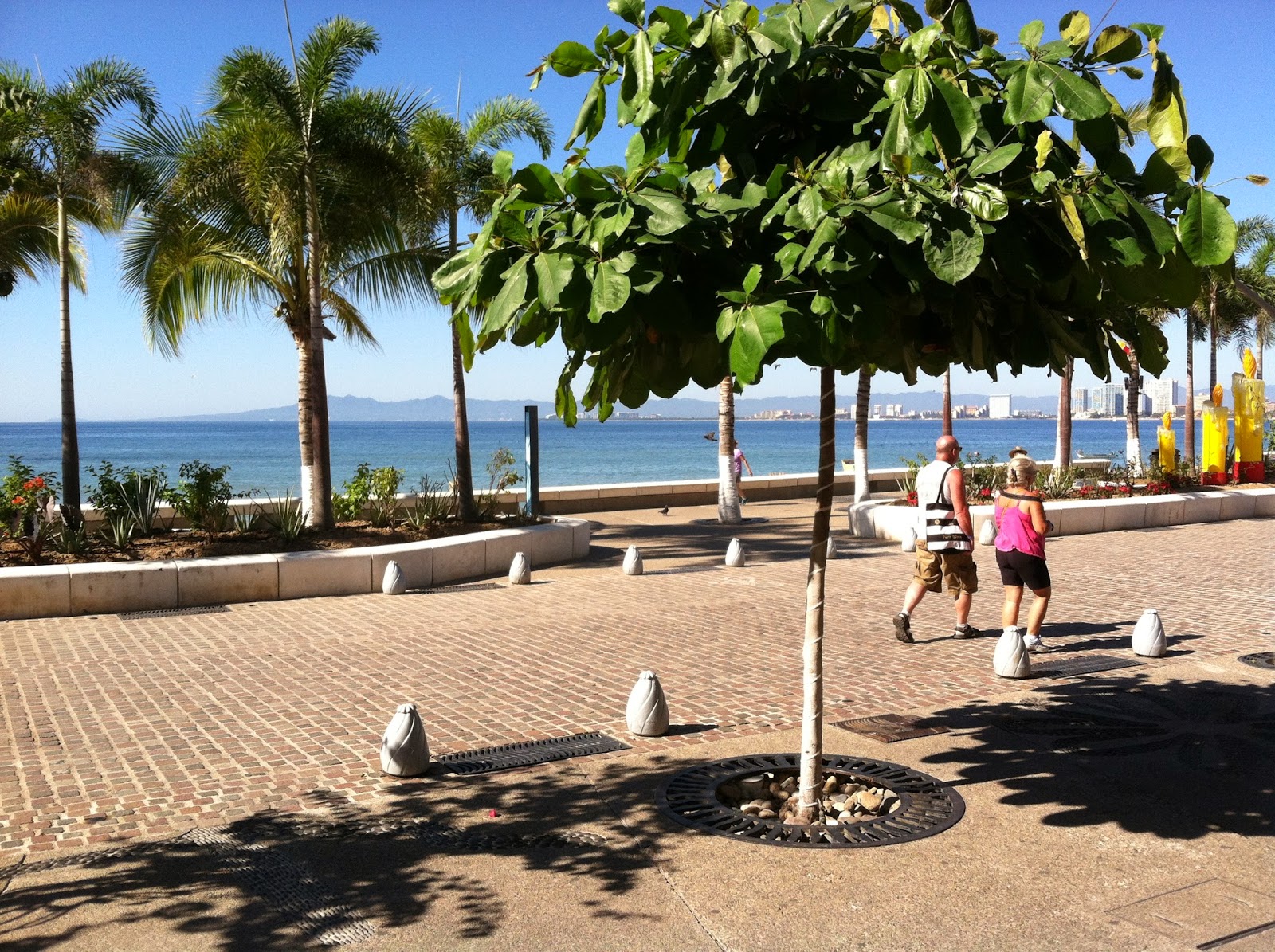
The Malecon In Puerto Vallarta
Mazatlan and Puerto Vallarta have malecons that stretch for miles. Both are wonderful walks along the sea. You hear the waves, watch them build and then roll ashore. You can watch the young surf the waves and families frolic on the beach as young ladies on skates dodge the traffic on the concrete. The big difference between the two cities?
Mazatlan's malecon is built between the sea and a four lane road, while the malecon in Puerto Vallarta is peaceful and no road. The road runs behind the buildings that border your walk.
Both have public art, yet PV's seems wider with trees and restaurants and shops.
Mazatlan Malecon
Mazatlan's malecon is built between the sea and a four lane road, while the malecon in Puerto Vallarta is peaceful and no road. The road runs behind the buildings that border your walk.
Both have public art, yet PV's seems wider with trees and restaurants and shops.
Labels:
Malecon,
Mazatlan,
Mexico,
Puerto Vallarta,
Travel
Sunday, May 18, 2014
Puerto Vallarta in January, 2014
Mexico! We made another trip to Mexico. This time to Puerto Vallarta for my 70th birthday. When I first visited Mazatlan, I said, "I'm falling in love with Mazatlan." Now, I could live here in PV.
Puerto Vallarta wraps around some say, “the largest bay in Mexico,” Banderas Bay, and is south of the airport. Prospective places to stay are listed as miles from the airport. There are four zones and each zone has its own vibe. The Marina is about 1½ miles from the airport and golfers love this area. The Hotel Zone is about 3 miles from the airport and caters to those who like all-inclusive. The Centro/downtown Zone is about 4 miles from the airport and is more commercial. Last is the Romantic Zone, about 5½ miles from the airport. The last two zones are on the malecon. We wanted to be close to the tourist attractions, sample many different restaurants, and have a great place to walk and dine with no cars to grate on your ears, so we chose the romantic zone.
We booked Playa Los Arcos for eight days after reading many reviews. The price was $1,564 including airfare. In addition, the hotel charged us $24 for the shuttle from the airport and the cab ride back to the airport was 120 pesos or about $10. The hotel was on the beach near the beginning of the malecon and close to many restaurants. Each day we began the day sitting on chaise lounges in the sand under umbrellas or by the three pools at the hotel. Pretty hard to resist the ocean and the breaking waves of refreshing water. The air temperature hovered around 82 degrees.
Puerto Vallarta wraps around some say, “the largest bay in Mexico,” Banderas Bay, and is south of the airport. Prospective places to stay are listed as miles from the airport. There are four zones and each zone has its own vibe. The Marina is about 1½ miles from the airport and golfers love this area. The Hotel Zone is about 3 miles from the airport and caters to those who like all-inclusive. The Centro/downtown Zone is about 4 miles from the airport and is more commercial. Last is the Romantic Zone, about 5½ miles from the airport. The last two zones are on the malecon. We wanted to be close to the tourist attractions, sample many different restaurants, and have a great place to walk and dine with no cars to grate on your ears, so we chose the romantic zone.
We booked Playa Los Arcos for eight days after reading many reviews. The price was $1,564 including airfare. In addition, the hotel charged us $24 for the shuttle from the airport and the cab ride back to the airport was 120 pesos or about $10. The hotel was on the beach near the beginning of the malecon and close to many restaurants. Each day we began the day sitting on chaise lounges in the sand under umbrellas or by the three pools at the hotel. Pretty hard to resist the ocean and the breaking waves of refreshing water. The air temperature hovered around 82 degrees.
Friday, May 16, 2014
U.S. retirees living well in Mexico
Thursday, December 5, 2013
3 Places To Live The American Retirement Dream Overseas
Kathleen Peddicord Publisher, Live and Invest Overseas recommends PV as one of three places to retire overseas:
#3: Puerto Vallarta, Mexico
Mexico is a big place with a bad reputation. The reputation isn't altogether undeserved, as drug cartels do control parts of this country but not all of it, and some of the most appealing regions for both living and investing sit outside the war zones. Mexico offers two long coasts, mountain towns, and colonial cities, plus Mayan ruins, jungle, rain forest, rivers, and lakes. It's also the most accessible "overseas" haven from the United States. You could drive back and forth if you wanted.
For all these reasons, Mexico is home to the biggest established populations of American retirees in the world, making it a great choice if you seek adventure with the comforts of home. Each of the several spots that expat retirees have targeted in this country offers a different lifestyle. Puerto Vallarta is the place to go for what could be described as luxury coastal living.
Puerto Vallarta is more expensive than other places where you might consider living or retiring overseas, but in Puerto Vallarta that's not the point. This isn't developing-world living. This stretch of Mexico's Pacific coastline has already been developed to a high level. Life here can be not only comfortable but easy and fully appointed. In Puerto Vallarta, you aren't buying for someday, as you can be in many coastal destinations in Central America. In Puerto Vallarta, you can buy a world-class lifestyle in a region with world-class beaches and ocean views that is supported, right now, by world-class golf courses, marinas, restaurants, and shopping. This is a lifestyle that is available only on a limited basis worldwide, a lifestyle that is truly (not metaphorically) comparable to the best you could enjoy in southern California if you could afford it. In Puerto Vallarta you can afford it even on an average retirement budget.
You could buy a small apartment outside Puerto Vallarta town for less than $100,000, or you could buy big and fancy for $1 million-plus. Whatever you buy, you could rent it out when you're not using it. The Puerto Vallarta region, including the emerging Riviera Nayarit that runs north from it along the coast, is an active tourist rental market with a track record.
#3: Puerto Vallarta, Mexico
Mexico is a big place with a bad reputation. The reputation isn't altogether undeserved, as drug cartels do control parts of this country but not all of it, and some of the most appealing regions for both living and investing sit outside the war zones. Mexico offers two long coasts, mountain towns, and colonial cities, plus Mayan ruins, jungle, rain forest, rivers, and lakes. It's also the most accessible "overseas" haven from the United States. You could drive back and forth if you wanted.
For all these reasons, Mexico is home to the biggest established populations of American retirees in the world, making it a great choice if you seek adventure with the comforts of home. Each of the several spots that expat retirees have targeted in this country offers a different lifestyle. Puerto Vallarta is the place to go for what could be described as luxury coastal living.
Puerto Vallarta is more expensive than other places where you might consider living or retiring overseas, but in Puerto Vallarta that's not the point. This isn't developing-world living. This stretch of Mexico's Pacific coastline has already been developed to a high level. Life here can be not only comfortable but easy and fully appointed. In Puerto Vallarta, you aren't buying for someday, as you can be in many coastal destinations in Central America. In Puerto Vallarta, you can buy a world-class lifestyle in a region with world-class beaches and ocean views that is supported, right now, by world-class golf courses, marinas, restaurants, and shopping. This is a lifestyle that is available only on a limited basis worldwide, a lifestyle that is truly (not metaphorically) comparable to the best you could enjoy in southern California if you could afford it. In Puerto Vallarta you can afford it even on an average retirement budget.
You could buy a small apartment outside Puerto Vallarta town for less than $100,000, or you could buy big and fancy for $1 million-plus. Whatever you buy, you could rent it out when you're not using it. The Puerto Vallarta region, including the emerging Riviera Nayarit that runs north from it along the coast, is an active tourist rental market with a track record.
Subscribe to:
Posts (Atom)


.jpg)